Showing posts with label complementarianism. Show all posts

Sunday, 16 August 2015

Ok Seriously

One more post on the Target gender-desegregation hoopla. Because I'm really frustrated and kind of horrified at the things people are saying.* I read this post by Matt Walsh because some of my Facebook friends 'like' his page (although I did decide to hide all posts from him in future because I need to live my life not constantly frustrated about this.) Anyways.

I have two sons who are into a broad variety of things, including dolls, construction vehicles, dance parties, and reading. I don't have a daughter, so I can't speak to what she would be like, although I remember being a little girl who loved biology (National Geographic wildlife specials all the way), fat novels, playing in the woods, and riding bikes and playing Red Rover with the neighbourhood kids. Chances are you have a similar story. You loved Barbies, climbing trees, and those foam 3D puzzles of architecture. You loved the Hardy Boys, card games, and a stuffed frog you took to bed with you every night even when you were way too old for it. None of these things was cause for much comment. Now, I'm not saying there were no problems with the expectations on kids in the past, of course, but the truth is that the toy aisle has gotten more gender-segregated in the last few decades. 

The thing is this: toy gender segregation is not about biblical manhood and womanhood. It's about money. Toymakers, broadly, don't give a plugged nickel whether their toys encourage girls to be nice, pretty, and domestic, and boys to be tough, athletic, and spatial.** They do, again broadly, care about their bottom line. If you can get siblings to play with different toys, because one of the siblings is a boy and two are girls, you've just sold that many more toys. If boys and girls can't play together in groups because boys and girls don't play the same group games, you've sold that many more toys. If, however, kids can happily play group games, pretend games, building toys, et al. in non-gender-specific ways, toymakers don't get to divide their markets into smaller, more lucrative categories. 

Why get into a righteous froth on behalf of toymakers' moneymaking categories? I talked a bit in my last post about how most of the toy segregations don't make sense and are actually discouraging the kinds of things we want to see in godly men and women. Let's go over it one more time. If your little girl plays with dinosaurs, wonderful-- she's cultivating a sense of joy and wonder in God's creation. If your little boy plays dolls, wonderful-- he's practicing to be the kind of father who's there, one-on-one with his kids, teaching them the truth as they stand and sit and walk. If your daughter loves hockey, perfect-- she's set on a path for enjoying the physical form she's been given, stewarding her body and health well, and learning to cooperate with others. If your son is dazzled by ballet, perfect-- he's getting set to grow into a man who appreciates the beauty and creativity of art and enjoys God's gift of music and dance as ways to praise him and communicate with each other. None of these things conflict in any way with Biblical categories of manhood and womanhood expressed within marriages and churches. None of these things have the slightest thing to do with sexual orientation or transgenderism. It's a crying shame to see people-- parents, even!-- acting as if it's somehow bad to let kids freely roam the toy aisles without a big sign insisting that what they like is for the other gender. It is also startlingly illogical. Surely letting kids like what they like is doing the precise opposite of encouraging gender confusion, by telling our little girls and boys that there are many ways to be a girl and many ways to be a boy, and in all that beautiful diversity, there is no need for one to long to be something other than what she is, something other than what he is: a unique person who loves, say, science experiments, Lego Star Wars, and paper doll kits, and is just right exactly the way they are.

*People are using words like 'sissifying' and 'pussifying' to describe this move, because A) this has anything to do with anybody being tough? and B) thanks for showing clearly with your word choice that yes, people do still think that female=weak and useless, so we DO need to break down these gender stereotypes; sorry Matt Walsh, when you say "Nobody ever said that girls can’t be strong or boys can’t be gentle" your own crowd is right there giving you the lie...) 

**Which, BTW, not Biblical criteria at all. That's just culture and tradition talking.

A Quick Crash Course...

...in why I write about gender stereotyping and feminism.

When Target makes a decision that allows kids to enjoy whatever toys they are drawn to without feeling as though they are making the 'wrong' choice, and a big crowd of people hop onto their Facebook page to tell them they are denying our God-ordained genders, kowtowing to the 'transbullies', and leading America further into the 'depraved' dark hole it's already in. GUYS. God didn't give Adam and Eve each a pile of approved toys. Kids are also not born with any particular proclivity to cars/blocks/actions figures vs. kitchen sets/baby dolls/pink dress up. None of these things are sexual. None of these things are inherently gendered. None of these things are treated in the Bible's discussion of gender, which instead focuses on things like honour, servant-heartedness, and love. Those are things I can do and be while moving heavy rocks to build a wall for my garden-- so why not a little girl playing with construction toys? Those are things my husband can do and be while cuddling our little boy before bedtime and singing him a lullaby-- so why not a little boy playing with a doll? These were things Jesus exemplified while heading up a bread and fish meal for a big crowd-- so why not a little boy playing kitchen?

What I'm getting at is, when you're upset about the breakdown of gender divides that do not exist in any way, shape, or form in the Bible, and invoking God to do it, you're doing it wrong. You're gypping a bunch of kids in the process. It hurts nobody to let kids like what they like without judgement. It will help kids, to feel free to explore and learn with a broader range of toys and games. It will help kids by letting them feel more confident in their choices and preferences. Putting extra-Biblical rules and restraints on little children is exactly the sort of thing the Bible frowns very strongly on. Unlike letting your daughter play with Avengers action figures and your son wear fairy wings, on which subject the Bible is utterly silent.

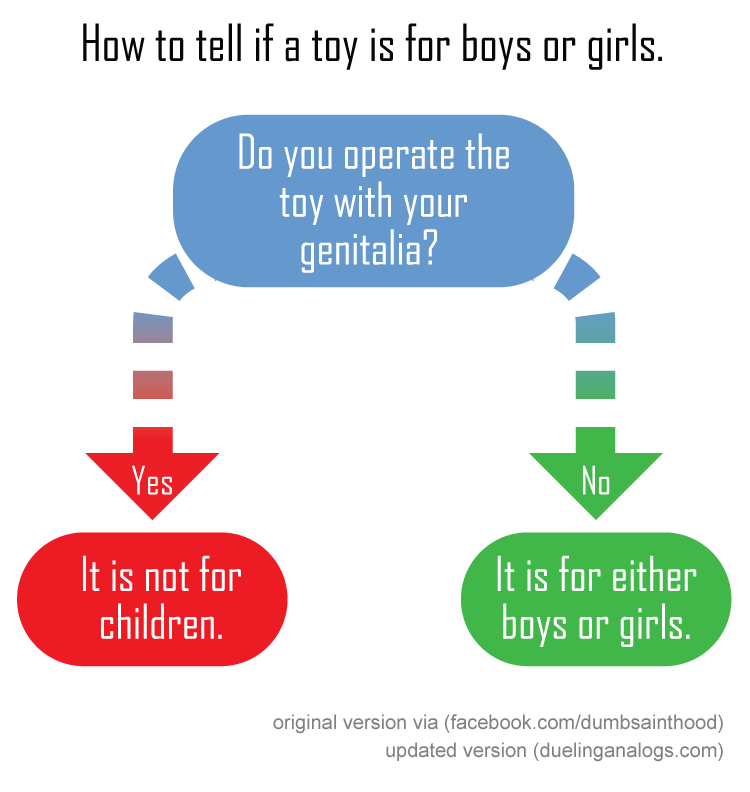
(Or maybe I just read the headline wrong, and Target actually replaced its whole toy section with a squad of evil child-corruptors handing out sexual literature? No? Then let me close with this handy flowchart:)


Saturday, 20 September 2014

The Manly Church

Today I want to talk a little bit about the common charge heard in Conservative/complementarian circles that today's church is 'feminised', springboarding off this article from Christianity Today called "Act Like Men: What It Means to Fight Like a Man", subtitled, Men, is [sic] your life characterised by courage, strength, and love?

Here's how the article starts: "One of the reasons many churches struggle is they're not a friendly place for men. Think about the worship service at your church. More than likely, there's a lot of talk about loving each other, but not much about fighting against sin or fighting for each other. There's holding hands when we sing, but not much locking arms as we get marching orders for the mission."

The article goes on to cite passages like 2 Timothy 4:7 ("I have fought the good fight, I have finished the race..."), Ephesians 6 ("Put on the full armor of God so that you can stand against the tactics of the Devil…so that you may be able to resist in the evil day, and having prepared everything, to take your stand."), and 1 Peter 5:8 ("Be serious! Be alert! Your adversary the Devil is prowling around like a roaring lion, looking for anyone he can devour.")

You may not be surprised to find that I take issue with this. Here's why: what they are talking about is not feminisation. It is just plain weak theology and vague experience-- and I refuse to accept that as inherent to my gender. "Is your church all about lovey-dovey pop-psychology stuff, with no serious, difficult looks at sin and struggle to be seen? LADIES."

Those passage referenced above? Are inspired Scripture intended for the whole of the church, not 'Notes from the Men's Manual of Being a Good Christian'. Battle language is part of our life as Christians; warring against the flesh, fleeing temptation, standing firm against the flaming darts of the enemy, being alert and watchful are the territory of every Christian. Being "characterised by courage, strength, and love"? Two-thirds of that dictum are in my blog title referencing Proverbs 31, the excellent wife.

I have always loved John Piper's description of "strong complementarian women" as having "massive steel in their backs, and theology in their brains." By all means, let us call churches to draw from the richness, depth, and strength of Scripture in their meetings instead of relying on niceness to save us. Let us face the darkness of our sin, let us ask the Spirit for self-control, endurance, and discipline along with our love, kindness, and gentleness-- and let all of us do this without drawing a line down the middle for gender, because that line is not written into God's Word. Let us not, however, make the mistake of calling a theologically-weak, feel-good, standardless church 'feminised'. Because, I beg your pardon, but that ain't my femininity.

Friday, 27 June 2014

Leading Like Christ

"Though the Father knew our frame prior to the incarnation and remembered “we are dust” (cf. Ps. 103:13, 14), the Son entered our fragile mortality in order to understand our weaknesses and become our sympathetic High Priest. These are the great lengths to which God went in order to listen to his people, his generosity bidding us to surrender our lives and receive from him grace for our weaknesses, mercy for our fears and failures. Isn’t it true that all of us—men and women—are led most eagerly by those who’ve attempted to walk the proverbial mile in our shoes?"
"...Too long, we’ve mistakenly billed women’s issues as the concerns of women alone—when pastors and husbands, if they want to lead well, must lean attentively into the conversations women are having... Men should seek to understand the intentions of women’s conferences, even as they should endeavor to read books written by women. In this way, they engage sympathetically with perspectives not their own, and concerns, both practical and theological, are refracted in different light. To return to my opening example, men may not struggle, for example, with splintered days and the dizzying sense of responsibility that comes from wearing many hats and spinning many plates. Yet if pastors and male teachers want to offer a sound theology of work, from the pulpit, someone needs to be talking about the laundry... When men understand the concerns of women—even try to imaginatively enter the struggles women face—they lead better. They lead like Christ."
-Jen Pollack Michel on TGC Blog

And this is why I am troubled by the way moviemakers overwhelmingly assume that women and girls will watch stories about men but men and boys will not watching stories about women. The way so many kids book default to a male as a main character. This is why I buy my two sons books with female main characters and watch movies with female main characters. This is why I blog about the Default Male and cite statistics about the underrepresentation of females in the media. This is why it matters-- this is an area the church should be leading, not trailing the world, and I want my sons to grow up knowing that they can learn from, enjoy, and see themselves reflected in the stories of women. I want them to lead like Christ.

Monday, 23 June 2014

Jen Wilkins on TGC. Read It.

On Daughters and Dating.

Dang. Straight. That's all I can say.

Except don't read the comments unless you like being depressed.

Thursday, 5 June 2014

The Great Against the Powerless

Sir Robert: "The other one is this. It's from a slightly older source. It is this: you shall not side with the great against the powerless."
Member of Parliament: "Mr. Speaker, point of order."
Sir Robert: "I am on my feet."
Member of Parliament: "Will you yield?"
Sir Robert: "I will not yield, Mr. Speaker. You shall not side with the great against the powerless. Have you heard those words, gentlemen? Do you recognize their source? From that same source, I add this injunction. It is this: what you do to the least of them you do to me. Now, now, gentlemen..."

-Excerpt from The Winslow Boy

I was recently asked why I write about women's issues, why I make it one of my interests and passions. My answer was twofold. One reason I wrote about in the past: I feel that misogyny is as much and more of a threat to what complementarians hold dear as gender blurring. The other is summarised beautifully by the above quote.

In the beginning of time, God created humans, without sin, in beautiful harmony, with binary gender, with love and relationship at the heart of what it is to be human. But we sinned. Our relationship with God was broken, and by extension our relationships amongst each other became broken. Ashamed but arrogant, humanity has been trying to make ourselves look better than we are ever since. Genocides, bullying, social climbing and materialistic greed, self-righteousness, self-harming, an obsessive pursuit of physical beauty or physical strength, "in" crowds and outcasts, unhealthy competition-- so much of what is sick in our world stems from the deep underlying knowledge of our fallen condition and our futile efforts to secure our standing without the sacrifice of Christ.

One way this manifests is in the strong-- whether socially, financially, physically, what have you-- using their strength to oppress the weak instead of to protect them.

God calls his people to protection of the disenfranchised, disadvantaged, and forgotten. This value was embedded deeply in the moral code of the Mosaic law. Over and over in the prophetic judgements against Israel is the refrain of their callous heart towards the poor and needy in their land. As this value relates in particular to women, 1 Peter 3:7 specifically enjoins husbands to show honour to the weaker vessel.

In a rightly ordered world, women, physically weaker in terms of sexual dimorphism, pregnancy, childbirth, nursing, and menstruation, would only be protected and honoured by men. This is not so. When we look at human history, we see that across cultures, across eras, across belief systems, women have been oppressed. Women have been denied protection under the law, we have been denied education, we have been denied sexual agency*. We have been subjected to physical alterations**, we have been denied employment and financial independence. We have been told our minds are weaker, our emotions hysterical, our bodies shameful. We have been denied dignity and a public voice.

Some will suggest this is a 'victim mentality' and that men suffer at the hands of women as well.  Of course they do; sin is not restricted to one gender. Individual women do great wrong against individual men. However, I strongly argue that the systemic, institutionalised oppression of men by women has been very rare if not unheard of in human history, and is likely to remain that way, given sinful human nature which sides with the strong and oppresses the weaker.

Perhaps I am overzealous in my commitment to women's rights. However, I think it prudent as a Christian to err on the side of being overzealous for the oppressed rather than the oppressor. Certainly being oppressed does not make one a saint, and the oppressed can be greedy, selfish, self-pitying, manipulative, and so on. But the sympathies of our Lord routinely fall on their side nonetheless, and I should prefer to do the same, in as balanced and Scriptural a way as I can. It is the opposite of what sinful nature would have us do: shut up and side with the strong, protect ourselves, ingratiate ourselves, cling to our own comfort, and try to get in on the benefits the strong are reaping.

Secular feminists frequently hold forth the hope that the work of feminism will eventually bring about a better world, one of equality for women. I hope the church rises ever closer to that standard, but I have not much hope for the fallen world to get there; not as it is now. However, one day the risen Redeemer Christ, in whom there is neither Jew nor Greek, male nor female, slave nor free, will come back and make all things right. Until then, "You shall not side with the great against the powerless"-- and "What you do to the least of them you do to me."

*From genital mutilation to child brides to rape and sex trafficking to sexual exploitation in advertising and media.
**From footbinding and neck rings to corsets and plastic surgery.

Friday, 29 November 2013

Focusing Our Firepower


In response to yesterday's blog post, I have been involved in a Facebook conversation with a friend discussing whether it is true that our culture views women as inferior. I wrote in my blog post that "...the church should claim the middle ground, passionately defending the beauty of binary gender as created and called 'good' by God, while at the same time standing firmly against any implied or outright attitudes that mark one gender as superior! ... And in our culture, the gender that tends to be portrayed as inferior is women." This friend argued that our culture has "spent many years trying to present women as equal to or even better than men". My response follows, as I think it merits wider discussion. 

"I agree that our culture would be quite unlikely to say outright that females are inferior. However, much like racism, which presents in subtle ways now that it is no longer socially acceptable to be overt about it, I do think mainstream media and those saturated in its thinking present a degraded, sexualised, and inferior view of women. The graphic I linked yesterday had many examples of this. The vast majority of tales of heroism, friendship, and character growth are fronted by male characters, while females are most often main characters in a romance story intended only for other females. I have explored on my blog dozens of other ways in which females are subtly presented as less valuable."
"Indeed, for the vast majority of history and still in the vast majority of the developing world, women are overtly considered less valuable, intelligent, and capable then men. This is true in the Muslim nations where women are hidden beneath robes as if shameful and have little to no civil rights in comparison to men, this is true in the African nations where females are routinely circumcised so that sexual pleasure becomes strictly male territory, this is true in India where little girls are given away as sexual toys in a parody of marriage to men old enough to be their grandfathers, this is true in China where female infants are aborted or abandoned in favour of males. It is only in the West and in the last fifty or so years that it even became inappropriate (in most contexts, unless it's the internet) to say that women are only good for cooking and looking pretty."
"As I have said repeatedly on my blog, I think the complementarian church is in grave danger of totally undermining its message if it sees feminism as its only enemy, since the enemy of misogyny is far more deeply entrenched over the world and across history. It feels to me a bit like if a movement for more racial equality in the church focused mainly on ways black culture excludes whites and ignored the long and bloody history of the ways whites have mistreated blacks. One is not the answer to the other, absolutely, but we should be very cautious before we decide which side deserves most of our firepower."

As always, deeply interested to hear your thoughts, arguments, and experience, whether here or on Facebook.

Wednesday, 12 June 2013

Some Heavy Reading For Your Wednesday Night

This article by Irvin A. Busenitz was just brought to my attention in the comments on my post Thoughts On "A (Somewhat) Scholarly Analysis Of Genesis 3:16"*. It features some rather dense, scholarly reading exploring the Hebrew words and use of context at play in Genesis 3:16.

If you're still in doubt about how to correctly interpret this passage, I would encourage you to read the whole article. I feel very confident after reading it that the new interpretation that developed during second-wave feminism-- that women desire to dominate men because of the curse-- is not the correct one.

If you're not up for reading all eleven pages, here's an excerpt from the conclusion:

"The central consideration in the interpretation of Gen 3:16b is context; the meaning of "desire" is best determined in the light of its immediate contextual setting. The context bespeaks procreation and the continuation of life, not the desire to dominate. Furthermore, to appeal to Gen 4:7 with its manifold obscurities to unlock the interpretive door of Gen 3:16 is to throw exegetical caution to the wind. It is much safer to apply the meaning of [Hebrew word] in Cont 7:10** to Gen 3:16, for while it does not enjoy the near proximity of Gen 4:7, its meaning is plain and its interpretation is vitually unquestioned. Consequently, it should be granted preeminence over Gen 4:7 and become the primary cross-reference in ascertaining the meaning of "desire.""
"The text does not sustain the interpretation that one aspect of the woman's judgment is that she will desire to dominate and control the man. The last phrase of Gen 3:16 is not a part of the judgment; it is an explanatino and description of conditions which will exist after the fall. Thus, the last phrase could be translated: "you you will still desire [as you did before the Fall, though now tainted by sin] your husband, and he will still rule [as he did before the Fall, though now tainted by sin] over you."


*I think Busenitz's article is more cautious with the text than article by Alsup which I originally posted. Both posit an alternative meaning for "her desire shall be for her husband" but I think Busenitz's requires less stretching of the text. At any rate, neither support the idea of female domination as part of the curse.
**That's Song of Solomon. Took me forever to figure that out so I'm letting you know now. Or maybe I'm the only one who might've been confused.

Sunday, 2 June 2013

Showing Honour

I was over at my in-laws last night and it often strikes me when I am with them what godly, lovely people they both are. One way I see this is the way my father-in-law will often disappear quietly into the kitchen after a busy meal. See, my in-laws are known for their hospitality, so their family of six (still at home) is often supplemented with lots of company. After a long day where both of them are tired, I suppose it would be easy for my in-laws to argue about who should wash dishes. My father-in-law's work involves lots of mental and physical exertion. My mother-in-law keeps a big family going with all the countless jobs that entails. But I've never seen them have that argument, while I have so often seen my father-in-law off in the kitchen, rallying the kids to come dry dishes.

It strikes me as such a fine example of the servant-leadership Christ wants the men of his Church to exhibit. No "I'm the man, I work hard all day and deserve a rest," no "I'm the man so I'm the breadwinner and you do the housework." Nothing like that. Instead, it's "I'm the man, and we're both tired but God gave me a stronger body and I will take care of you by doing these dishes at the end of a hard day." So wonderful.

And I'm the indirect beneficiary because my husband does the same. I know he hates washing dishes, but now that I'm pregnant and thus bone-weary for most of the day, he rises to the occasion, using his strength to serve. It is such a blessing to me, and perfectly pictures the selfless way Christ serves his bride the Church.

"Likewise, husbands, live with your wives in an understanding way, showing honor to the woman as the weaker vessel, since they are heirs with you of the grace of life, so that your prayers may not be hindered." 1 Peter 3:7, ESV

Friday, 24 May 2013

Thoughts On "A (Somewhat) Scholarly Analysis of Genesis 3:16"

I recently purchased Wayne Grudem's Systematic Theology as a little gift for myself. Because it's been on my mind a lot lately, one of the first parts I dipped into was Chapter 22: Man As Male and Female. This is basically Grudem's overview of complementarianism and many parts of it were very good. A quote I especially loved was, "In practical terms, we must never think that there are any second-class citizens in the church. Whether someone is a man or woman, employer or employee, Jew or Gentile, black or white, rich or poor, healthy or ill, strong or weak, attractive or unattractive, extremely intelligent or slow to learn, all are equally valuable to God and should be equally valuable to one another as well. This equality is an amazing and wonderful element of the Christian faith and sets Christianity apart from almost all religions and societies and cultures." Praise God!

However. In the course of his breakdown of how pre-Fall Scripture already teaches different roles for men and women, Grudem footnotes Susan T. Foh's article in the Westminster Theological Journal in 1975, which argues that Genesis 3:16 should be re-examined in light of feminism (meaning second-wave feminism) and that "her desire shall be for her husband" should be interpreted that the woman's desire will be to conquer her husband. This is quite a leap from the ordinary meaning of desire, and a new idea theologically-- I would like to refer you to this article by Wendy Horger Alsup on Practical Theology for Women which breaks down this argument hermeneutically and discusses what Reformed theologians have historically thought on the subject, and, I think, makes a good case that what is actually meant here is a straightforward reading of "desire" as we usually read it: longing or craving.

Wendy writes: "What if we read Genesis 3:16 in the straightforward way translators write it—her desire (strong craving/longing) will be for her husband—a way that was among the common views of it, according to Foh, before she put out her new view in reaction to the 2nd wave of feminism?... A straightforward reading such as Vos', Keil's, and Delitzsch's, requires no theological backflips. The woman's root problem is that, even though child birth is painful and the man rules her, she still has a morbid craving for him, looking to him in completely unhealthy ways that do not reflect her status as image bearer of God." 

I do strongly encourage you to read the whole article; it's really fabulous. In closing, one more quote which uses this straightforward reading of the Genesis 3:16 curse to draw some conclusions about the current state of gender relationships: "No, feminism isn't the ultimate problem. The problem didn't start as women wanting control over the men in their lives. Women set up men as idols and looked to them to provide emotionally, spiritually, physically what only God can provide. Apart from Christ, men oppressed them in return, hence the modern coping mechanisms of independence, self-sufficiency, and control (often ineffective) for dealing with that oppression. The curse read at face value reflects the real issue, and the gospel is the clear answer."