Sunday, 16 August 2015

Ok Seriously

One more post on the Target gender-desegregation hoopla. Because I'm really frustrated and kind of horrified at the things people are saying.* I read this post by Matt Walsh because some of my Facebook friends 'like' his page (although I did decide to hide all posts from him in future because I need to live my life not constantly frustrated about this.) Anyways.

I have two sons who are into a broad variety of things, including dolls, construction vehicles, dance parties, and reading. I don't have a daughter, so I can't speak to what she would be like, although I remember being a little girl who loved biology (National Geographic wildlife specials all the way), fat novels, playing in the woods, and riding bikes and playing Red Rover with the neighbourhood kids. Chances are you have a similar story. You loved Barbies, climbing trees, and those foam 3D puzzles of architecture. You loved the Hardy Boys, card games, and a stuffed frog you took to bed with you every night even when you were way too old for it. None of these things was cause for much comment. Now, I'm not saying there were no problems with the expectations on kids in the past, of course, but the truth is that the toy aisle has gotten more gender-segregated in the last few decades. 

The thing is this: toy gender segregation is not about biblical manhood and womanhood. It's about money. Toymakers, broadly, don't give a plugged nickel whether their toys encourage girls to be nice, pretty, and domestic, and boys to be tough, athletic, and spatial.** They do, again broadly, care about their bottom line. If you can get siblings to play with different toys, because one of the siblings is a boy and two are girls, you've just sold that many more toys. If boys and girls can't play together in groups because boys and girls don't play the same group games, you've sold that many more toys. If, however, kids can happily play group games, pretend games, building toys, et al. in non-gender-specific ways, toymakers don't get to divide their markets into smaller, more lucrative categories. 

Why get into a righteous froth on behalf of toymakers' moneymaking categories? I talked a bit in my last post about how most of the toy segregations don't make sense and are actually discouraging the kinds of things we want to see in godly men and women. Let's go over it one more time. If your little girl plays with dinosaurs, wonderful-- she's cultivating a sense of joy and wonder in God's creation. If your little boy plays dolls, wonderful-- he's practicing to be the kind of father who's there, one-on-one with his kids, teaching them the truth as they stand and sit and walk. If your daughter loves hockey, perfect-- she's set on a path for enjoying the physical form she's been given, stewarding her body and health well, and learning to cooperate with others. If your son is dazzled by ballet, perfect-- he's getting set to grow into a man who appreciates the beauty and creativity of art and enjoys God's gift of music and dance as ways to praise him and communicate with each other. None of these things conflict in any way with Biblical categories of manhood and womanhood expressed within marriages and churches. None of these things have the slightest thing to do with sexual orientation or transgenderism. It's a crying shame to see people-- parents, even!-- acting as if it's somehow bad to let kids freely roam the toy aisles without a big sign insisting that what they like is for the other gender. It is also startlingly illogical. Surely letting kids like what they like is doing the precise opposite of encouraging gender confusion, by telling our little girls and boys that there are many ways to be a girl and many ways to be a boy, and in all that beautiful diversity, there is no need for one to long to be something other than what she is, something other than what he is: a unique person who loves, say, science experiments, Lego Star Wars, and paper doll kits, and is just right exactly the way they are.

*People are using words like 'sissifying' and 'pussifying' to describe this move, because A) this has anything to do with anybody being tough? and B) thanks for showing clearly with your word choice that yes, people do still think that female=weak and useless, so we DO need to break down these gender stereotypes; sorry Matt Walsh, when you say "Nobody ever said that girls can’t be strong or boys can’t be gentle" your own crowd is right there giving you the lie...) 

**Which, BTW, not Biblical criteria at all. That's just culture and tradition talking.

A Quick Crash Course...

...in why I write about gender stereotyping and feminism.

When Target makes a decision that allows kids to enjoy whatever toys they are drawn to without feeling as though they are making the 'wrong' choice, and a big crowd of people hop onto their Facebook page to tell them they are denying our God-ordained genders, kowtowing to the 'transbullies', and leading America further into the 'depraved' dark hole it's already in. GUYS. God didn't give Adam and Eve each a pile of approved toys. Kids are also not born with any particular proclivity to cars/blocks/actions figures vs. kitchen sets/baby dolls/pink dress up. None of these things are sexual. None of these things are inherently gendered. None of these things are treated in the Bible's discussion of gender, which instead focuses on things like honour, servant-heartedness, and love. Those are things I can do and be while moving heavy rocks to build a wall for my garden-- so why not a little girl playing with construction toys? Those are things my husband can do and be while cuddling our little boy before bedtime and singing him a lullaby-- so why not a little boy playing with a doll? These were things Jesus exemplified while heading up a bread and fish meal for a big crowd-- so why not a little boy playing kitchen?

What I'm getting at is, when you're upset about the breakdown of gender divides that do not exist in any way, shape, or form in the Bible, and invoking God to do it, you're doing it wrong. You're gypping a bunch of kids in the process. It hurts nobody to let kids like what they like without judgement. It will help kids, to feel free to explore and learn with a broader range of toys and games. It will help kids by letting them feel more confident in their choices and preferences. Putting extra-Biblical rules and restraints on little children is exactly the sort of thing the Bible frowns very strongly on. Unlike letting your daughter play with Avengers action figures and your son wear fairy wings, on which subject the Bible is utterly silent.

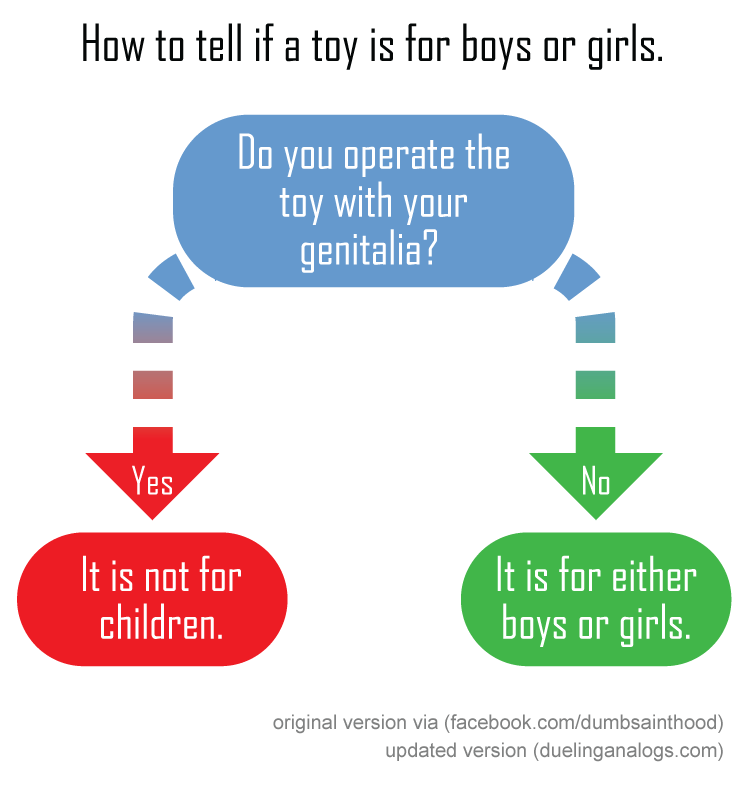
(Or maybe I just read the headline wrong, and Target actually replaced its whole toy section with a squad of evil child-corruptors handing out sexual literature? No? Then let me close with this handy flowchart:)


Friday, 5 June 2015

Film Fridays: Mad Max: Fury Road


When I first saw the Mad Max trailer, I almost shuddered. I honestly thought it looked like one of the stupidest movies I'd ever seen. Inexplicable babes and dystopian car chases and apparently nothing else. Then it opened, and Steven started hinting that we might want to go see it; the internet buzz was that it was fabulous. I started softening, and agreed to watch it. We watched two of the originals first, and I'd recommend it. Anyhow, we were way behind everyone else in seeing it because parents, but if you haven't seen it yet, rent the originals off iTunes (they're like $4) and then for heaven's sake hie yourself to the movie theatre and go see this movie because it is awesome. And probably wait to read this post, because spoilers.

Visually the movie is stunning. The scenery is incredible, especially for a barren wasteland, and the prop department must've had so much fun designing the vehicles-- everything, the polecats, the hot-rod tank, the costuming, the engine-based religion, all harks back to and expands on the offbeat motorcycle-gang world introduced in the original, but taken to an epic scale. 

Actually it felt like that progression in a lot of ways. The original was a (kind of awful yet oddly beautiful yet weird) very intimate story in the midst of apocalypse. No cities levelled, no epic battles, just open road and a few motorcycles and cars, really; a story about a family. The second one expanded the scale to a settlement big enough to need a bus to get around. From the looks of the trailer the third is a slightly larger world still. And then this, a handful of cities. Really, it's still quite small, Joe's territory not more than a day's journey around. But the environment got harsher, the cultures stranger, the violence broader, and Max himself more laconic and withdrawn.

It's no secret this is being hailed as a feminist film, but really what I really loved about it was it was just a great story. The women didn't feel like tokens, like cardboard cutouts, like embodied concepts about feminism, but like real humans beings with passion and resonance and variety. You know, like women actually are.

So, here I go with the breakdown:

Role of Women: In the world of the film, the women of the Citadel are breeders. The most telling line to me was just a casual comment between two of the warboys after the Five Wives are discovered to be escaped along with Furiosa: "She took a lot of his [Immortan Joe's] stuff." "What stuff?" "His breeders." Although Furiosa is entrusted with driving a war rig, most of the women we see in the Citadel are caged and controlled: the nursing mothers hooked up to constant breast pumps, the wives in their warren. In the commentary of the film, though, the women are, to quote, "not things." The moment when you first see the Wives, slender, sparsely clad and luscious, (described in the previous link as "what would happen if someone decided to heavily arm a Burberry ad"), the knee-jerk reaction is to assume they're what they look like, what they would be in almost any other action movie: eye-candy. My gut reaction was to object, as I would in any other action movie. But, of course, in the story eye candy was what they were, the role they had been forced into by nature of their lives. But the story took you beyond that. Into their loyalty, dignity, and ferocious passion to be free. Early in the movie, during the first chase into the dust storm I think it was, a war boy drops into the vehicle. The five young women, out in the rough, dark world for the first time in their lives, with no knowledge of weapons, with soft hands and long flowing hair and smooth skin, pounce on him, grabbing and biting, their drive to be free crackling across the screen. I swear, in any other movie ever those women would've been screaming and cringing. It was a beautiful moment to see onscreen. Another equally beautiful one was when the heavily-pregnant Angharad places herself and her child between the man who had owned and abused her, and the woman who was helping her escape. Her dignity in that moment was palpable. Great article that outlines a little more of this aspect here.
Sexualisation of Women: Coming out of the theatre, I was reminded of the movie Sucker Punch, the one and only movie I walked out of midway through at the theatre. It purports to be a story about young women fighting back against sexual abuse, but the moviemakers sexualised the actresses so heavily that it felt like it was spitting in its own face. Fury Road was the opposite. A story about women sexualised and abused and objectified completely by their world, who are not at all sexualised in the film. No panning shots up their legs. No suggestion that the hero is entitled to sexual access to them by virtue of helping them (see Skyfall). Even the way they were dressed, which could easily have been presented very sexually, was instead a piece of storytelling, an imposition on them from outside that didn't detract from their dignity and strength. 
Bechdel Test Pass/Fail: Pass, of course. 
Male:Female Ratio: The pursuers are exclusively male, and there are a lot of them, so in that sense they outnumber the females, but of the characters you get to know and connect with, females outnumber. Outnumber, yes. 

Are you buying your movie tickets yet? Need more convincing? Everything here. 
Still not convinced? Look at this picture of Road Warrior Mad Max and COME ON.

Oh, and one final good moment. At the end of the film, the lactating mothers you saw at the beginning, they ones who just felt like props establishing the place of women in this society as, like, human cows? They're the ones who step out and open the water gates. They are not things, either.

Sunday, 28 September 2014

The Christian Purity Movement

Enjoyed this post from Sheila Wray Gregoire's blog* on the Christian purity culture. Here are my two favourite quotes:

"What makes it especially problematic, though, is the way we frame the whole issue. “Boys are walking hormones who will lust all over anyone in a tight sweater. It’s your job to keep him from lusting!” Girls’ sex drives are barely mentioned, while boys are presented as testosterone-induced drones, rendered helpless by cleavage. Girls become responsible not just for their own purity, but for boys’ purity, too, and sex becomes something boys want but girls have to fight against. No wonder so many girls grow up ambivalent about sex!"

And (emphasis mine):
"I was recently talking with a 19-year-old young woman who didn’t date in high school, but is now in quite a serious relationship at university. When she and her boyfriend were first discussing boundaries, they decided not to define “how far they should go” because as soon as you draw a line, you immediately rush to that line and start flirting with it. Instead, they decided that they would start every time that they’re together by focusing on Jesus. Make Jesus the centre, and the rest will follow.

We have become so scared that teens will have sex that we have created a purity culture that is centred around rules and shame rather than centred around Jesus. Yes, we should be modest, and yes, we should be pure. But we’ll achieve that much faster by having a relationship with Christ than by memorizing a bunch of rules."

Like. DANG.

*Which is a great read for married women, btw; Gregoire strongly affirms and fights in the corner of female sexuality, although she is guilty of stereotyping at times.

Sunday, 21 September 2014

Biblical Models, Not Cultural Stereotypes

Appreciated these thoughts on making your church a safe place for people with same-sex attraction, particularly these thoughts on gender stereotyping. It does matter in our churches; it does.

"4. Deal with biblical models of masculinity and femininity, rather than cultural stereotypes. 

Battles with SSA can sometimes be related to a sense of not quite measuring up to expected norms of what a man or woman is meant to be like. So when the church reinforces superficial cultural stereotypes, the effect can be to worsen this sense of isolation and not quite measuring up.

For example, to imply that men are supposed to be into sports or fixing their own car, or that women are supposed to enjoy crafts and will want to “talk about everything,” is to deal in cultural rather than biblical ideas of how God has made us. This stereotyping can actually end up overlooking many ways in which people are reflecting some of the biblical aspects of manhood and womanhood that culture overlooks."

Saturday, 20 September 2014

The Problem With Stereotypes


Link Pack

Just a few links from around the web that I found interesting:

Some thoughts on the phrase, "Real men don't do x." Following on from the Ray Rice story:
"Saying “real men don’t do (x)” is a feel good, self centered mechanism that men use to relieve themselves of critically examining the world we live in and how their roles as both beneficiaries and agents of misogyny sustains a world where such violence is possible."

How gender stereotypes affect biologists' interpretations and discoveries:
"[S]perm turned out to be feeble swimmers... The last thing you’d want a sperm to be is a highly effective burrower, because it would end up burrowing into the first obstacle it encountered. You want a sperm that’s good at getting away from things... The team went on to determine that the sperm tries to pull its getaway act even on the egg itself, but is held down against its struggles by molecules on the surface of the egg that hook together with counterparts on the sperm’s surface, fastening the sperm until the egg can absorb it. Yet even after having revealed the sperm to be an escape artist and the egg to be a chemically active sperm catcher, even after discussing the egg’s role in tethering the sperm, the research team continued for another three years to describe the sperm’s role as actively penetrating the egg."

Heartbreaking article on Rape Culture in the Alaskan Wilderness:
"In the late 1830s, small pox wiped out a third of the Native population in southern and western Alaska. In 1900, a flu and measles epidemic did the same—or worse, by some estimates. Some villages were decimated; in others, there weren’t enough left alive to bury the dead."
"Then, shortly after the second pandemic, many Native Alaskan children were shipped off to boarding schools—some as young as 6 years old—and many were beaten, sexually abused, and urged to forget their languages and cultures. In a few villages, multimillion-dollar lawsuits were filed against Catholic priests and church workers for molesting almost an entire generation of Alaska Native children..."
"...This is further exacerbated by the fact that traumatic experiences can lead to alcohol and drug abuse, and alcohol and drug abuse can lead to further traumatization. "It’s like a circle, you can’t take just one; they’re all linked together," says Cynthia Erickson. "You’re born, you’re molested—kick another domino down.""

A great challenge regarding the statistics on collegiate rape:
""The price of a college education should not include a 1 in 5 chance of being sexually assaulted." – Sen. Kirsten Gillibrand."

And finally, Immodesty All Over the Map, an exploration of different cultural modesty standards and how they should make us slow to judge others:
"A fixation on our own definition of modesty threatens to warp our perceptions and hurt our interactions with others—particularly as we venture outside our own culture."

The Manly Church

Today I want to talk a little bit about the common charge heard in Conservative/complementarian circles that today's church is 'feminised', springboarding off this article from Christianity Today called "Act Like Men: What It Means to Fight Like a Man", subtitled, Men, is [sic] your life characterised by courage, strength, and love?

Here's how the article starts: "One of the reasons many churches struggle is they're not a friendly place for men. Think about the worship service at your church. More than likely, there's a lot of talk about loving each other, but not much about fighting against sin or fighting for each other. There's holding hands when we sing, but not much locking arms as we get marching orders for the mission."

The article goes on to cite passages like 2 Timothy 4:7 ("I have fought the good fight, I have finished the race..."), Ephesians 6 ("Put on the full armor of God so that you can stand against the tactics of the Devil…so that you may be able to resist in the evil day, and having prepared everything, to take your stand."), and 1 Peter 5:8 ("Be serious! Be alert! Your adversary the Devil is prowling around like a roaring lion, looking for anyone he can devour.")

You may not be surprised to find that I take issue with this. Here's why: what they are talking about is not feminisation. It is just plain weak theology and vague experience-- and I refuse to accept that as inherent to my gender. "Is your church all about lovey-dovey pop-psychology stuff, with no serious, difficult looks at sin and struggle to be seen? LADIES."

Those passage referenced above? Are inspired Scripture intended for the whole of the church, not 'Notes from the Men's Manual of Being a Good Christian'. Battle language is part of our life as Christians; warring against the flesh, fleeing temptation, standing firm against the flaming darts of the enemy, being alert and watchful are the territory of every Christian. Being "characterised by courage, strength, and love"? Two-thirds of that dictum are in my blog title referencing Proverbs 31, the excellent wife.

I have always loved John Piper's description of "strong complementarian women" as having "massive steel in their backs, and theology in their brains." By all means, let us call churches to draw from the richness, depth, and strength of Scripture in their meetings instead of relying on niceness to save us. Let us face the darkness of our sin, let us ask the Spirit for self-control, endurance, and discipline along with our love, kindness, and gentleness-- and let all of us do this without drawing a line down the middle for gender, because that line is not written into God's Word. Let us not, however, make the mistake of calling a theologically-weak, feel-good, standardless church 'feminised'. Because, I beg your pardon, but that ain't my femininity.

Friday, 18 July 2014

What the...?


Dear Creators of The Great Mouse Detective (1986),

Please explain to me how this is an okay character to include in a kid's movie. Especially a kid's movie that includes (up to this point, because I turned it off STAT) only four female characters (housekeeper, little girl/catalyst for male action, buxom pub waitress and this sultry number). Especially as a whole suggestive musical number with lyrics like "Boys, what you're hopin' for will come true, let me be good to you," and "Hey fellas,  I'll take off all my blues/Hey fellas, there's nothing I won't do just for you,"  and not just a passing shot. LIKE ACTUALLY. How is this okay?

Wednesday, 2 July 2014

Always A Member of A Class

"...not that every woman is, in virtue of her sex, as strong, clever, artistic, level-headed, industrious and so forth as any man that can be mentioned; but, that a woman is just as much an ordinary human being as a man, with the same individual preferences, and with just as much right to the tastes and preferences of an individual. What is repugnant to every human being is to be reckoned always as a member of a class and not as an individual person."

Dorothy Sayers hitting it out of the park.

Friday, 27 June 2014

Lady Legends: Andi Petrillo

Andi Petrillo, Hockey Night In Canada reporter, Olympic and FIFA host. Because I love to see a woman who loves sports making a name for herself right in there with the guys.

Leading Like Christ

"Though the Father knew our frame prior to the incarnation and remembered “we are dust” (cf. Ps. 103:13, 14), the Son entered our fragile mortality in order to understand our weaknesses and become our sympathetic High Priest. These are the great lengths to which God went in order to listen to his people, his generosity bidding us to surrender our lives and receive from him grace for our weaknesses, mercy for our fears and failures. Isn’t it true that all of us—men and women—are led most eagerly by those who’ve attempted to walk the proverbial mile in our shoes?"
"...Too long, we’ve mistakenly billed women’s issues as the concerns of women alone—when pastors and husbands, if they want to lead well, must lean attentively into the conversations women are having... Men should seek to understand the intentions of women’s conferences, even as they should endeavor to read books written by women. In this way, they engage sympathetically with perspectives not their own, and concerns, both practical and theological, are refracted in different light. To return to my opening example, men may not struggle, for example, with splintered days and the dizzying sense of responsibility that comes from wearing many hats and spinning many plates. Yet if pastors and male teachers want to offer a sound theology of work, from the pulpit, someone needs to be talking about the laundry... When men understand the concerns of women—even try to imaginatively enter the struggles women face—they lead better. They lead like Christ."
-Jen Pollack Michel on TGC Blog

And this is why I am troubled by the way moviemakers overwhelmingly assume that women and girls will watch stories about men but men and boys will not watching stories about women. The way so many kids book default to a male as a main character. This is why I buy my two sons books with female main characters and watch movies with female main characters. This is why I blog about the Default Male and cite statistics about the underrepresentation of females in the media. This is why it matters-- this is an area the church should be leading, not trailing the world, and I want my sons to grow up knowing that they can learn from, enjoy, and see themselves reflected in the stories of women. I want them to lead like Christ.

Monday, 23 June 2014

Jen Wilkins on TGC. Read It.

On Daughters and Dating.

Dang. Straight. That's all I can say.

Except don't read the comments unless you like being depressed.

Saturday, 21 June 2014

Film Review: Haute Cuisine


Haute Cuisine (based on the true story of Danièle Delpeuch) tells the story of Hortense Laborie, appointed to be personal chef to the President of France. Before we get to the nitty-gritty of the film, can I just say that the food in the movie was so beautiful? I wanted to cook the whole time I was watching it. And eat. I really wanted to eat.

Role of Women: I loved the main female character. She is gracious, competent, passionate, staunch. She's unafraid of adventures, travelling from the President's private kitchen to a remote Antarctic base. She's an artist. She's a little bit unruly, running the kitchen her own way despite the strict rules that surround her. She's wise.
Sexualisation of Women: There are some coarse moments in the film, a few jokes from male characters about the only woman around. Broadly, though, Hortense is valued for her character, personality, and talent, not her body.
Bechdel Test Pass/Fail: Pass. Hortense has conversations with the President's secretary (not sure she was named; it was all subtitles so I might just have missed it), and with the journalist in Antarctica.
Male:Female Ratio: There's only four or five female characters. This is part of the plot, of course, as Hortense forges her own path through the male-dominated world of the palais kitchens. I think they did a good job of not overemphasizing it, that is, the plot was more about the rules and restrictions of the palais versus Hortense's passionate, artistic cooking style, but still.

Thursday, 5 June 2014

The Great Against the Powerless

Sir Robert: "The other one is this. It's from a slightly older source. It is this: you shall not side with the great against the powerless."
Member of Parliament: "Mr. Speaker, point of order."
Sir Robert: "I am on my feet."
Member of Parliament: "Will you yield?"
Sir Robert: "I will not yield, Mr. Speaker. You shall not side with the great against the powerless. Have you heard those words, gentlemen? Do you recognize their source? From that same source, I add this injunction. It is this: what you do to the least of them you do to me. Now, now, gentlemen..."

-Excerpt from The Winslow Boy

I was recently asked why I write about women's issues, why I make it one of my interests and passions. My answer was twofold. One reason I wrote about in the past: I feel that misogyny is as much and more of a threat to what complementarians hold dear as gender blurring. The other is summarised beautifully by the above quote.

In the beginning of time, God created humans, without sin, in beautiful harmony, with binary gender, with love and relationship at the heart of what it is to be human. But we sinned. Our relationship with God was broken, and by extension our relationships amongst each other became broken. Ashamed but arrogant, humanity has been trying to make ourselves look better than we are ever since. Genocides, bullying, social climbing and materialistic greed, self-righteousness, self-harming, an obsessive pursuit of physical beauty or physical strength, "in" crowds and outcasts, unhealthy competition-- so much of what is sick in our world stems from the deep underlying knowledge of our fallen condition and our futile efforts to secure our standing without the sacrifice of Christ.

One way this manifests is in the strong-- whether socially, financially, physically, what have you-- using their strength to oppress the weak instead of to protect them.

God calls his people to protection of the disenfranchised, disadvantaged, and forgotten. This value was embedded deeply in the moral code of the Mosaic law. Over and over in the prophetic judgements against Israel is the refrain of their callous heart towards the poor and needy in their land. As this value relates in particular to women, 1 Peter 3:7 specifically enjoins husbands to show honour to the weaker vessel.

In a rightly ordered world, women, physically weaker in terms of sexual dimorphism, pregnancy, childbirth, nursing, and menstruation, would only be protected and honoured by men. This is not so. When we look at human history, we see that across cultures, across eras, across belief systems, women have been oppressed. Women have been denied protection under the law, we have been denied education, we have been denied sexual agency*. We have been subjected to physical alterations**, we have been denied employment and financial independence. We have been told our minds are weaker, our emotions hysterical, our bodies shameful. We have been denied dignity and a public voice.

Some will suggest this is a 'victim mentality' and that men suffer at the hands of women as well.  Of course they do; sin is not restricted to one gender. Individual women do great wrong against individual men. However, I strongly argue that the systemic, institutionalised oppression of men by women has been very rare if not unheard of in human history, and is likely to remain that way, given sinful human nature which sides with the strong and oppresses the weaker.

Perhaps I am overzealous in my commitment to women's rights. However, I think it prudent as a Christian to err on the side of being overzealous for the oppressed rather than the oppressor. Certainly being oppressed does not make one a saint, and the oppressed can be greedy, selfish, self-pitying, manipulative, and so on. But the sympathies of our Lord routinely fall on their side nonetheless, and I should prefer to do the same, in as balanced and Scriptural a way as I can. It is the opposite of what sinful nature would have us do: shut up and side with the strong, protect ourselves, ingratiate ourselves, cling to our own comfort, and try to get in on the benefits the strong are reaping.

Secular feminists frequently hold forth the hope that the work of feminism will eventually bring about a better world, one of equality for women. I hope the church rises ever closer to that standard, but I have not much hope for the fallen world to get there; not as it is now. However, one day the risen Redeemer Christ, in whom there is neither Jew nor Greek, male nor female, slave nor free, will come back and make all things right. Until then, "You shall not side with the great against the powerless"-- and "What you do to the least of them you do to me."

*From genital mutilation to child brides to rape and sex trafficking to sexual exploitation in advertising and media.
**From footbinding and neck rings to corsets and plastic surgery.

Thursday, 1 May 2014

Complementarianism and Natural Leaders

The other weekend, I was involved in a discussion about whether complementarianism was based on fundamental characteristics of men and women. The argument I was opposing ran something like this: men in general have personalities and intrinsic qualities better suited to leadership positions, which is why God assigns them as natural leaders (not just in the church and in the home, but in business, politics, and other secular spheres as well.) Now, as is common in a group discussion, nobody really gets to explain their points to the fullest, so I wanted to sit down and write out my point of view in full, for my own sake and for the interest of anyone else who reads it.

Aside from the scientific evidence* and my personal experience (i.e. seeing a pretty even spread of personality characteristics across my circles of acquaintanceship), the main reason I disagree with this argument is because I think it actually undermines the entire position of complementarity (ironically enough, since the people who hold to deep intrinsic differences as the reason for complementarity would intend to uphold it). There are three ways in which I think this argument undermines complementarianism.

First, it borrows a leaf from the egalitarian position that a person's talents and characteristics would be the strongest influencer to God in determining who should be given which tasks among his people. But in looking at Scripture, I don't see evidence of this. I see the God who chose stuttering Moses as the spokesperson to a power-mad Pharaoh, insignificant David as the most important king of Israel, the prostitute Rahab and the foreigner Ruth as key players in the line of the promised Messiah, Christ-hating Paul as the great missionary of the early church. We serve a God who delights to use the weak to do what we would humanly assign to the strong. 1 Corinthians 1 leaves us in no doubt of that: "God chose what is foolish in the world to shame the wise; God chose what is weak in the world to shame the strong; God chose what is low and despised in the world, even things that are not, to bring to nothing things that are, so that no human being might boast in the presence of God."Now, this is not to say that God never uses people's natural talents and inclinations to work His purposes; of course he does. I merely wish to point out that it is a misrepresentation of God to assume that that would be as important to Him as it is to us. God does use people's talents. He also uses them in spite of their weaknesses.

Second, it demeans the power of Christ and the Holy Spirit within the Trinity. As complementarians, we understand complementing roles to be a reflection of the complementing roles within the Trinity. We affirm that while God the Father, the Son and Holy Spirit are the same in essence and divinity, there is within the Trinity a hierarchy in which Christ submits in everything to the Father and the Spirit is subjected to the Son's authority. If we are to follow this parallel through logically whilst assuming that male-female roles in the church and home are based on ability, we would then have to assume that the Father is more powerful and better suited to leadership than the Son, who is in turn more powerful and better suited to leadership than the Spirit. But the very beauty of Christ's submission to the point of death is that he was powerful enough to escape his death at any time. Satan tempted Christ to this very thing in the wilderness, urging him to throw off his self-sacrificing submission to the Father's will and seize kingship of the Earth by his own strength. In turn, we see that the Spirit is capable of great, awe-inspiring acts of healing, revival, and other miraculous events, but He chooses most often to work quietly away at our hearts, doing the humble and largely unseen work of rooting out sin in God's people. Thus I would argue that the roles within the Trinity-- and by parallel the roles within the church and family-- as not primarily based on ability, but on willing submission to God's redemptive purposes.

Thirdly, and perhaps most practically, if it were true that male-female roles were assigned based on intrinsic suitability, surely that would excuse anyone who deviated from this general norm from submitting to these roles? If we accept that men are generally more aggressive, competitive, authoritative, and logical and thus better suited to leadership, while women are generally more gentle, cooperative, supportive, and emotional and thus better suited to following, then wouldn't we need to logically allow the women with more leadership ability to use their God-given abilities in a Sunday service, or let more passive, suggestible men let their wives take over in providing direction to their families? After all, if God assigns the roles based on what we're naturally good at, that would show that He wants us to do the things we're naturally good at. The logical outcome of an ability-based role distinction seems to me to be functional egalitarianism.

In the past, many arguments for male leadership in the church included false affirmations of women's emotional hysteria, inferior intelligence, and less discerning minds. Today, let us not be the generation of the church who seeks to root God's assigned role distinction in women's inability to lead. It will make us look foolish in the eyes of anyone who has ever seen a woman competent in leadership, and ultimately it will not lend strength to our position.

*Which, for example, tells us that men and women are much more neurologically similar than they are different, and that our hormonal differences grow more or less pronounced in direct relation to how pronounced the difference in our activities are.

Wednesday, 2 April 2014

Lady Legends: Katherine Switzer

Katherine Switzer, first woman to run the Boston Marathon as a numbered entry*, in 1967.


*Without official permission; "Race official Jock Semple attempted to physically remove her from the race, and according to Switzer said, "Get the hell out of my race and give me those numbers.""

Friday, 29 November 2013

Focusing Our Firepower


In response to yesterday's blog post, I have been involved in a Facebook conversation with a friend discussing whether it is true that our culture views women as inferior. I wrote in my blog post that "...the church should claim the middle ground, passionately defending the beauty of binary gender as created and called 'good' by God, while at the same time standing firmly against any implied or outright attitudes that mark one gender as superior! ... And in our culture, the gender that tends to be portrayed as inferior is women." This friend argued that our culture has "spent many years trying to present women as equal to or even better than men". My response follows, as I think it merits wider discussion. 

"I agree that our culture would be quite unlikely to say outright that females are inferior. However, much like racism, which presents in subtle ways now that it is no longer socially acceptable to be overt about it, I do think mainstream media and those saturated in its thinking present a degraded, sexualised, and inferior view of women. The graphic I linked yesterday had many examples of this. The vast majority of tales of heroism, friendship, and character growth are fronted by male characters, while females are most often main characters in a romance story intended only for other females. I have explored on my blog dozens of other ways in which females are subtly presented as less valuable."
"Indeed, for the vast majority of history and still in the vast majority of the developing world, women are overtly considered less valuable, intelligent, and capable then men. This is true in the Muslim nations where women are hidden beneath robes as if shameful and have little to no civil rights in comparison to men, this is true in the African nations where females are routinely circumcised so that sexual pleasure becomes strictly male territory, this is true in India where little girls are given away as sexual toys in a parody of marriage to men old enough to be their grandfathers, this is true in China where female infants are aborted or abandoned in favour of males. It is only in the West and in the last fifty or so years that it even became inappropriate (in most contexts, unless it's the internet) to say that women are only good for cooking and looking pretty."
"As I have said repeatedly on my blog, I think the complementarian church is in grave danger of totally undermining its message if it sees feminism as its only enemy, since the enemy of misogyny is far more deeply entrenched over the world and across history. It feels to me a bit like if a movement for more racial equality in the church focused mainly on ways black culture excludes whites and ignored the long and bloody history of the ways whites have mistreated blacks. One is not the answer to the other, absolutely, but we should be very cautious before we decide which side deserves most of our firepower."

As always, deeply interested to hear your thoughts, arguments, and experience, whether here or on Facebook.

Thursday, 28 November 2013

Thoughts on the NYFA's Infographic

Since the graphic is so unwieldy, I thought I'd better break this into two posts.

Quick thoughts: what we see revealed by this infographic is an industry that sells a very rigid, narrowly defined ideal of femininity to both women and men. Although half of audiences are female, the industry is dominated both financially and in terms of physical presence by men. This means that what we see on our movie screens-- the sexually postured, youthful, largely silent and subservient female explained in the first section of the infographic-- is a construct designed to appeal to the lowest common denominator being sold by what is largely a group of amoral, godless, and money-hungry males (I'm making assumptions here, but given the material the film industry routinely pumps out, I think they're pretty likely to be true.)

There are two points of consideration I'd like to draw from this. One is how we as Christians evaluate the films we watch-- and the ones we choose not to. It is easy, for example, to decide a movie isn't appropriate because "there's too much nudity" or "the actresses are all dressed immodestly". However, I think it is very important that we move beyond just "that isn't decent/modest" to "that isn't fair or honouring." There is a very real and present pressure on actresses to be sexy and to act sexually and our critique needs to incorporate an understanding of how sexualised female characters in the majority of our narratives contribute to rape, sexual harassment, and the sexual entitlement claimed by so many men of our culture. Are we going into the conversation with our sons beyond just telling them it's not appropriate for them to look at women's bodies in those contexts, to talk about ways in which this harms the actual women in the world around them, such situations as one where a couple of schoolboys can rape a young woman while all their male classmates look on and not one intervenes or goes for the authorities? Simply turning off the film without having these types of conversations effectively condemns the immodestly dressed actress without also explaining that a portion of the blame-- perhaps the lion's share-- lies with those who provide the funding, advertising, and influence to make that a criteria for an actress's success: the largely male portion of the industry.*

The second point I want to think about is something I mentioned in this recent post, about how the bulk of pop culture is radically sidelining, limiting, and tightly defining femininity rather than blurring the lines between the two genders. Pop culture creates a caricature of womanhood in which a beautiful, youthful physical appearance is paramount, the ability to attract a romantic/sexual partner is more important than any true talents, and articulateness, intelligence, and character are of minimal significance. On the other side, a small subsection of our culture pushes against this by arguing all gender differences are social constructs and should be done away with altogether. Surely the church should claim the middle ground, passionately defending the beauty of binary gender as created and called 'good' by God, while at the same time standing firmly against any implied or outright attitudes that mark one gender as superior!**

*Another portion of the blame lies with the men who act upon the ideas about women portrayed in mainstream media, and that's another important conversation to have with our sons, but that's for another blog post, I think.
**And in our culture, the gender that tends to be portrayed as 'inferior' is women, which is why I write the blog posts I write. 

New York Film Acadamy's Infographic on Gender Inequality in the Film Industry

New York Film Academy takes a look at gender inequality in film
Courtesy of: New York Film Academy